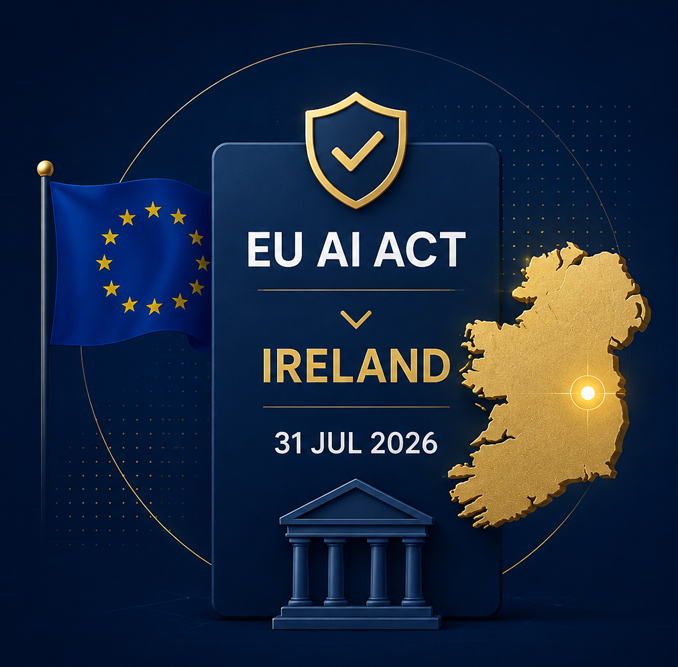
The Regulation of Artificial Intelligence Act 2026 (No. 31 of 2026) came into force on 31 July 2026, establishing the AI Office of Ireland and empowering 15 sectoral regulators to enforce the EU Artificial Intelligence Act.
On 2 August 2026, the majority of the EU AI Act became enforceable. Key obligations — including AI literacy (Article 4), prohibited practices (Article 5), and transparency requirements (Article 50) — are already in effect and can result in fines.
The Irish legislation implements the EU AI Act penalty framework, with sanctions varying according to the type of infringement.
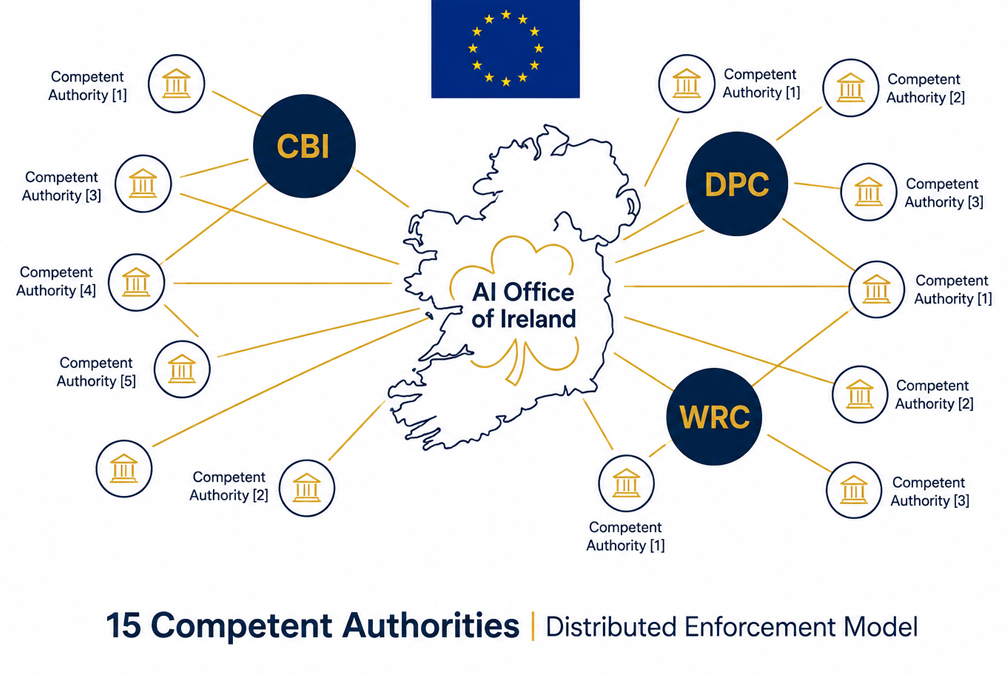
Ireland uses a distributed regulatory model for the EU AI Act, with 15 designated Competent Authorities operating across different sectors and areas of responsibility. The AI Office of Ireland acts as the central coordinating authority.
Central Bank of Ireland — Financial Services
Data Protection Commission — Data Protection
Workplace Relations Commission — Employment
HPRA — Health Products
HSE — Healthcare
ComReg — Communications
Systems and practices considered incompatible with EU fundamental rights and safety requirements.
High-risk systems can be subject to governance, documentation, risk management, monitoring and other regulatory obligations.
Certain AI systems are subject to transparency requirements regarding how AI is used or how content is generated.
Many AI applications fall into lower-risk categories with fewer mandatory requirements under the AI Act.
Access official legislation and government guidance on the EU AI Act and its implementation in Ireland.